Portable Trees

written by

Joel Salatin

posted on

July 1, 2025

Today's Polyface patrons, unfortunately, do not have the privilege of meeting my dad, who was a genius and visionary. His one negative trait was becoming weary of routine; he loved the new thing, the innovation. Much of his early innovation after we came to Swoope in 1961 was about stopping biological leaks or wastage.

How do you leverage the juvenile growth spurt in grass? How do you feed earthworms and build soil with on-site material? And one of the biggest ones: how do you capture manure and urine generated by grazing animals?

As we began moving cows from paddock to paddock with his portable electric fencing system, he saw a desperate need to make portable shade for the herd's comfort and especially to spread pasture droppings around. On hot summer days, animals, like people, look for shade. Historically, this means trees.
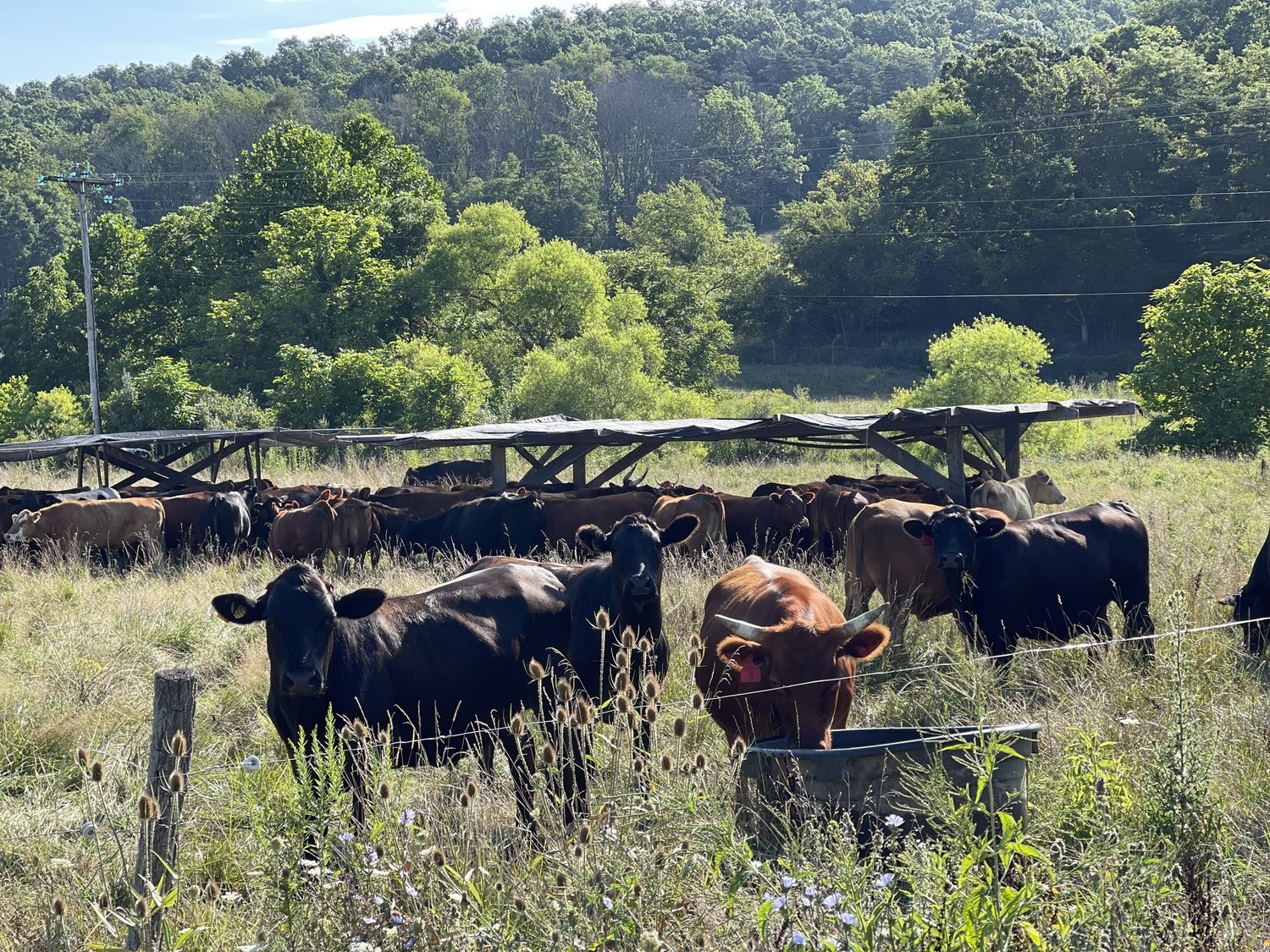
IMG_2051.jpeg


But trees are not everywhere and trees don't disperse the fertility. They instead offer campsites for cows, concentrating the droppings instead of spreading them, and turn into incubators for parasites and pathogenic organisms. Besides, the deep-rooted trees don't need the manure; the pasture needs the benefit of animal droppings.

Thus began a project to create a shademobile that could act like a portable tree. As early as 1820 John Taylor of Caroline, a friend and neighbor of Thomas Jefferson, in his book Arator mentions the need for an "ambulatory shade structure" for cows to strategically place their droppings in the field. But no one had done it until Dad built one.

He found a burned-out 50-foot mobile home, towed it to the farm, and began retrofitting it into a 20 foot wide by 50 foot long tricycle shademobile. Big enough for about 100 head of cattle, it literally drove our fertility engine. In those days, with poor soils and lots of brambles and woody weeds, the results were dramatic. We could park that thing on some Devil's Shoe String and the next year that rectangle was solid white clover. No seed; just heavy impaction and manure.

The green rectangles had a 5-year effect and began transforming our worn-out pastures into lush vegetation. For many years that shademobile sheltered the cows and enabled us to strategically place their droppings where they were needed most. The shade also reduced ammonia vaporization from urine and manure.

Over the years, however, that rigid 50x20 design became problematic because it was too big to go down tree-lined farm lanes and certainly impossible to take down a public road. When Polyface began renting nearby properties in the early 1990s, as part of our ongoing expansion, we needed something that could be transported down a public road. An outfit began building a circular shademobile that could collapse but it was extremely expensive--$23,000.

We began experimenting with smaller models on retrofitted and extended hay wagon chassis. We've built several and could hook them together to accommodate a larger herd. But hay wagons are hard to tow down the road, and the knock-down to 8 ft. and subsequent re-furling of the shade cloth canopy takes a couple of people and some time. They work, but not efficiently enough to say "we've arrived."

Around the dinner table, then, we brainstormed many ideas. One was a light conduit grid held aloft by helium weather balloons. In typical brainstorm-running humor, we imagined attaching it to a cow. Wherever she walked, that's where the shade would be.

Currently, we are working with a fellow in Missouri who has designed a glorified umbrella. It works just like an umbrella with a center pedestal and crank-up tension. He's built several, and we have Gen1, Gen2, and Gen3; a total of 3 prototypes we are using in the field to test functionality and durability.

We don't know if this is the optimal design. We've discussed rigid inflatables and horizontally collapsible trusses. It's all on the table, but we believe in the next couple of years we'll arrive at an affordable, efficient, durable model to take dad's original concept to the next level.

The bottom line is this: at Polyface, we never stop refining and innovating in order to do what is right and better. Our commitment is to come alongside biological processes and enhance them. Conventional industrial agriculture cares not a whit about natural biological processes. It views all life as a mechanical issue.

We view life as fundamentally biological. Our mechanics are not supposed to override biology with disrespect; they are meant to caress ecological needs with our ingenuity. This brings inherent abundance and immunological vibrancy.

Be assured, your continued interest and patronage enable our ongoing innovations into the future. 

Thank you.

Joel Salatin

More from the blog

Duplication

  "How does this scale?"  Whenever someone asks me that question, the underlying assumption is that production volume requires consolidation, concentration, and centralization.           In other words, the only way to feed the world is to make bigger chicken houses in one place, bigger canneries in one place, bigger machines and bigger warehouses.  I remember well being vilified by a Smithsonian historian at a food conference where he and I were both on a panel.                     When I dared to suggest bigger is not always better, he interrupted me and ranted for 10 minutes on why bigger is always better.  "A bigger fort was always bigger than a smaller one.  A bigger gun was always better than a smaller one."  He went on and on about how historical accuracy and authenticity demands addiction to bigger.                   But biology is not forts and guns.  It's not mechanical.  Critters have an optimal size.  As animal behaviorist guru Temple Grandin says, living things demand energy for three things:  reproduction, growth, and immunological function.  All three must be in balance.  When anyone selects for only one of those traits, the other two suffer.  That's why American dairy cows only have two lactations on average.  When they milk as heavily as our one-trait genetic selection asks, they don't breed and have all sorts of sickness problems.                   Nature does not scale through concentration; it scales with duplication.  If nature wants more oak, it doesn't make one big tree; it makes acorns.  If nature wants more milk, it doesn't make a great big cow; it makes calves.  If nature wants more tomatoes, it doesn't make a monster tomato plant; it makes a bunch of seeds that make more tomato plants.  Nature scales with duplication.                   At Polyface, rather than having a chicken house big enough for 15,000 chickens, we have 170 little 120 square foot portable shelters holding 75 birds apiece and giving us cumulative capacity for 15,000.  But they're spread out in modules, duplicated, to give us the production volume.                   We run pigs in groupings of 35-50.  A Smithfield confinement facility might house 5,000 hogs in a bigger-than-football-field-sized facility.  The stench is unbearable.  By spreading these pigs out across the landscape in small groups we get the same scale without any of the ecological, immunological, or animal welfare dysfunction.                   This could even be said of farming in general.  People see the massive corn, soybean, and alfalfa farms in the mid-west and wonder how we would possibly survive without those massive, single-species outfits.  The fact is they aren't even producing food.  Half the soybeans are exported to other countries; those markets are drying up rapidly with competition from other countries like Uruguay, Paraguay, Argentina, and Brazil.  Nearly half the corn goes to taxpayer-subsidized ethanol.  The alfalfa goes to Japan and Saudi Arabia to feed racehorses.  By and large, all that production isn't even food.                   The fact is we don't need to produce all those commodities and even if we needed it all for food, we could do it in a more spread out, diversified platform.  America has 35 million acres in lawns.  We have 36 million acres housing and feeding recreational horses.  All of this could be turned into duplicative production, like acorns for oak trees.                   My point is this:  scale as commonly understood in modern American lexicon is completely anti-ecological.  The real mechanism for scale is duplication.  A more democratized production creating volume through multiplicative nodes is the way nature works.  This is why farms like Polyface, with spread out infrastructure in repeated modules offers multiple advantages.                   Polyface can't feed the world by itself, and we have no desire to build an empire trying to.  But thousands of Polyfaces can feed the world.  Indeed, they're the only way to do it for the next 500 years.  This is one reason why we invest heavily in germinating new young farmers. Our stewardship and apprenticeship programs are all about this kind of duplication.                   In fact, Aug. 21-22 we're hosting the Stockman Grass Farmer's Launching Young Farmers conference where we'll feature 8 of our graduates who were 20 years old, no money, no land, and at 40 are full-time farming without government subsidies.  If you ever dreamed of bootstrapping a farming career, you should come.  We still have room.  It will be the most profound agricultural conference in America this year.  Information is on our website on the education tab.                   For most of you, the fact that you keep us in business to duplicate production and the farmers who will carry these principles forward, indicates your heart investing in an authentic food and farming model.  Thank you for making it all possible.