Scents of Spring

written by

Joel Salatin

posted on

April 8, 2025

Why does Polyface smell like a brewery right now?  Because we're pigaerating.

It's one of my most enjoyable smells of spring because I know it's converting fermenting bedding into aerobic compost.  And I don't have to do anything but enjoy the wafting, wonderful odors.  

I wish I could package the odors and send them to you, but you'll just have to imagine it.  Or come and visit.

In the winter, when we feed hay to the cows, we soak up their manure and urine with wood chips and old junky hay.  

Let's go back to the 1960s.  

We had about a dozen cows, and each weekend, when Dad was home from his town accounting job, Saturday morning chores included shoveling out the concrete barn floor.

Dad designed and built a V-slotted feeder gate that we would push through the hay stack as the cows ate the hay off the face.  It was a beautiful picture of conversion.  

Hay is simply dried grass; think of it like grass raisins.  
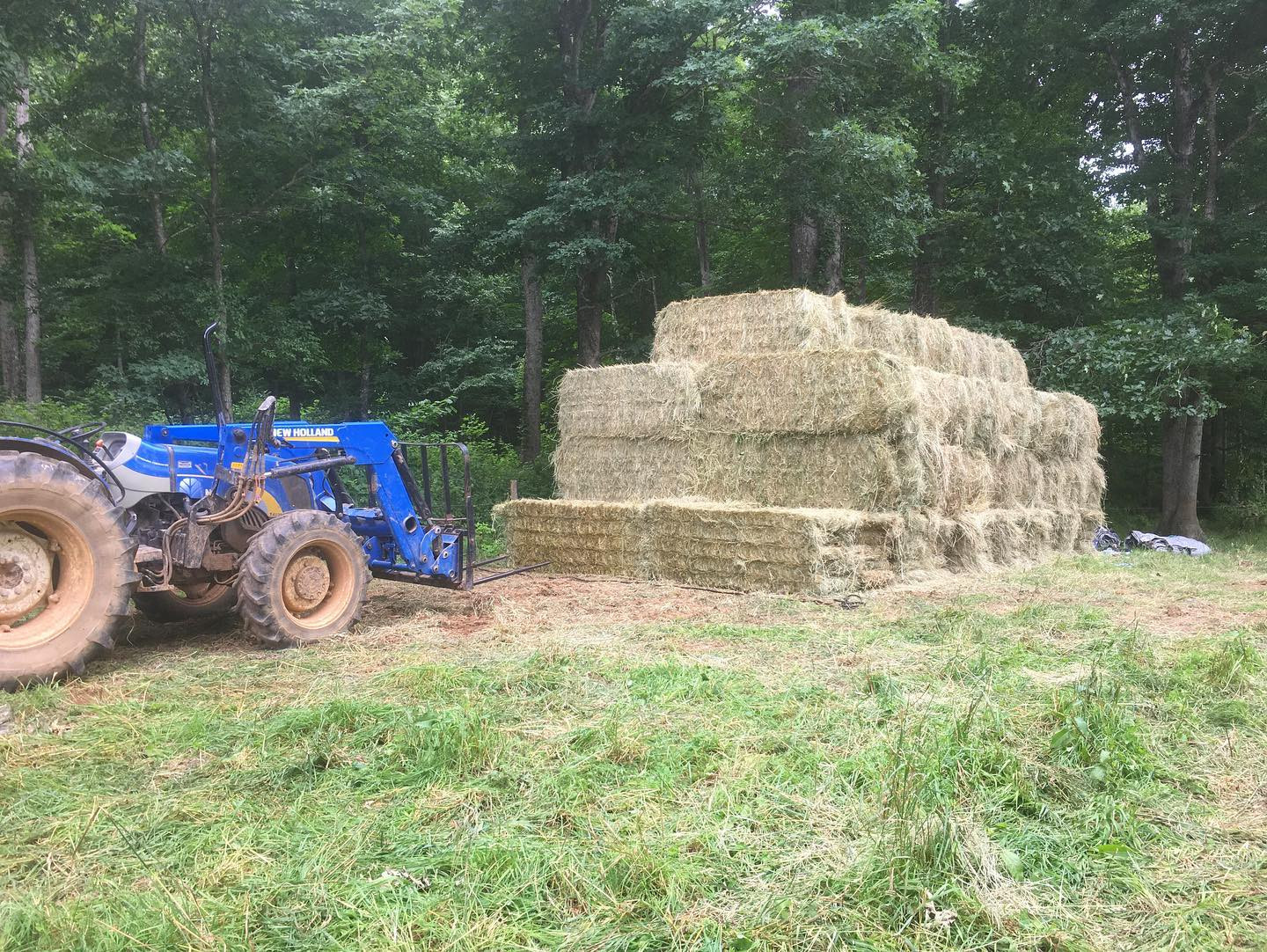
Hay.jpg

Cows lined up at the gate, ate hay, and pooped out their rear end--an extremely visceral look at rapid

decomposition.  I view the cow as a Nascar compost pile, rapidly converting carbon into concentrated fertility.

Dropping some 50 pounds of manure and urine daily, these benevolent beasts placidly go about their business without a care about toilet etiquette.  They poop anywhere.  The concrete pad under the haystack grew dimensionally as the cows ate through the stack during the winter.

If we didn't clean it out, they'd get dirty; hence, the Saturday rendezvous with the cow toilet.  

We'd shovel it into a manure spreader and spread it on the field.  

manure-spreader.jpg

A manure spreader is one of the coolest machines in the world.  

It has beaters and spinning fingers that fling the manure out in a nice pattern, scattering it on the ground.  Think of it like a huge butter-knife to spread the cows' goodies on the field like a giant piece of bread.

We started noticing something.  What we spread in January and early February didn't make any difference on the soil when spring came and the grass greened up.  But what we spread in late February and early March, right at the end of winter, made the grass turn dark green and grow like crazy.  The manure spreader strips looked like green paint on the field.

What was the difference?  Same material, same cows, same field; different time. 

In short, that fresh manure and urine were full of nutrients that were highly soluble and volatile.  If it snowed or rained, they washed into the groundwater, away from the topsoil.  If it was dry, they vaporized into the atmosphere - we all know what that smells like.

This is why New York City, many years ago, made it illegal to spread manure on the entire Hudson Valley from early December until about March 1.  

Manure spread during that time ended up in New York City's water supply.  

Why?  

In the winter, soil microbes go to sleep for a long winter's nap.  Earthworms curl up into a ball and await warmer soil temperatures.  Essentially, the soil sponge shuts down, unable to metabolize those dead-of-winter nutrients, regardless of whether they're organic or not.  Soil microbes don't eat when they're asleep.  Kind of like people.

With that observation, we realized we needed to somehow hang on to those nutrients through the dead-of-winter and await spreading when the soil began to wake up during spring warmer temperatures.  We needed carbon to bind the nutrients in a chemical sponge, to stabilize them.  We began searching for carbon and found Staunton's (our nearest city's) leaf pile.  I spent many an hour hand-shoveling leaves into our pickup truck, then bringing them home.

This was the beginning of our "carbonaceous diaper" concept.  

With only a dozen cows, it was not a tremendous amount of shoveling.  The carbon gave the cows a nice clean lounge area; every few days, we'd cover the manure and urine as things got a bit sloppy, and give the cows a nice clean lounge area.  When spring came, we'd haul it to the fields in the manure spreader, and it started to really show vitality.

We knew we were onto something.  

Manure-spreader-spring.jpg

As the fertility cycle increased grass growth, we realized we needed to up our game on the carbon and the

ability to spread it.  We bought a wood chipper and began chipping branches from our firewood work.  

Then the bedding started getting deep enough to ferment.  That presented new challenges because fermentation creates pickling aldehydes toxic to aerobic microbes inhabiting the top six inches of soil.  It's like salt water and fresh water: completely different microbial communities.

We needed to convert the anaerobic bedding pack to aerobic before spreading.  

That pushed us into composting.  

By this time, we're in the early 1980s and able to feed 25 cows.  

The first couple of years, I hand shoveled the bedding into a compost pile about 8 feet wide, 5 feet high, and 45 feet long.  You know the old adage:  "The older I get, the better I was."  The compost was magic.  It still is.

Soon, we were up to 40, and then 50 cows, and I asked a neighbor with a front-end loader to come and dig it out so I could make windrow compost piles.  We did that for years until I had the idea of letting pigs do all that aerating. 

I did a small experiment with two pigs, and it worked beautifully; now we were off to the races. I put corn in the bedding and let the pigs search for their food; in doing so, they went through the manure pack like a big egg beater.  

Hence, our term "pigaerators."  

Pigaerating.jpg

Today, we use 80 pounds of corn per cubic yard of carbon and dozens of hogs to turn mountains of carbonaceous diaper into aerobic compost that drives our fertility engine.

By the mid-90s, we purchased our first front-end loader, upgraded our chipper, and augmented our own carbon with leaves from Staunton's pile - I'd drive the tractor down there and we'd fill a dump truck.  

Fertility continued to improve and we were able to increase to 75 cows.  

It was steady, strategic progress in soil development and fertility, all created by leveraging the winter-generated cow dung into aerobic compost.  And those sweet conversion smells became a spring regular. 

Today, we have hundreds of cows and an industrial chipper, three manure spreaders, several front-end loaders, and hundreds of tons of compost created by a hundred hogs.  

It's a wonderful sight.  

You can almost feel the earthworms dancing, knowing that soon they'll have compost spread on their heads.  Happy days.

If you visit the farm right now, you'll get to enjoy that special aroma of fermented manure and urine turned into compost that smells so good you could almost put milk on it and eat it for breakfast.  

The pigs will finish all this work by the end of April.  

For those of you who have read Omnivore's Dilemma by Michael Pollan, the pigaerating is what captured his attention and made him return to Polyface for a week in the summer and choose to feature us.

This was beyond organic.  It was grass farming to the third degree.

We welcome you to experience the magic of pigaerating.  And oh, the aroma.  It's the aroma of magic happening.  Come and enjoy.

Joel

pigs

Pork

cows

beef

season

More from the blog

Why Good Food Costs More - and Why It Matters

Many people wonder why foods grown with care for the land, animals, and farmers often cost more than the industrial options that line grocery store shelves. It’s an important and honest question, and it deserves a thoughtful answer. Let’s start with the basics: food affects everything. Our health, our communities, and the land that sustains us are all tied to how food is produced.  Unfortunately, problems begin when the cheapest foods tend to be the most processed, the most subsidized, and the most aggressively marketed. It's easy to feel boxed into these choices, especially when you look at the price tag. But sometimes, and for lots of folks, it's easy to forget that those cheap foods come with a much higher price tag later on, whether it's just how we feel as processed foods affect our bodies, or the bills that stack up after doctor's visits. I know that after I eat ultra-processed foods (often full of unspecified additives, dyes, stabilizing ingredients, etc.), I don't feel great.  I'm so thankful to say that I grew up eating mostly grass-fed beef. As a child, I remember wondering why "grocery store" beef was so different and "yucky". (I just thought only my grandpa could raise good beef.) As I've spent the last decade and a half eating mostly pastured chicken and pork, too, I can tell a definite difference when I do eat less "expensive", commercially raised foods. My grandpa definitely raised good beef, but I've realized now that it was his methods that made all the difference.  Sustainably raised, grass-fed, pastured meat is meat that is being raised as it was intended to be, and therefore, it can do for our bodies what it was intended to do: nourish, fill, and bless. When I make better choices with my meals, I'm less tired, experience fewer mood swings, don't get hungry again as soon, experience less brain fog, and have fewer stomach and digestive issues. I've realized that the true price of food is how it affects my body and makes me feel. I can choose foods that come with a 'price tag,' and will help me to feel my best, or I can choose food with a hidden cost later on, as it takes a toll on my body.At Polyface, we have a simple belief: when animals live the way they’re designed to live, they, the land, and the people who eat from it thrive. Compared to conventional, industrially raised meat, regeneratively raised, grass-fed meat offers: Healthier fat profiles — Cattle and poultry raised on diverse pastures often contain more omega-3s and fewer inflammatory omega-6 fats than animals fed grain in confinement. Higher micronutrient density — Pasture-raised meats and eggs contain more vitamins A, D, and E, along with minerals like iron and selenium—thanks to clean sunlight, fresh grasses, and good exercise. Cleaner food with fewer inputs — Animals raised on pasture don’t require routine antibiotics, growth promotants, or chemical inputs that are standard in confinement systems. Food that nourishes more with less — Nutrient-dense food tends to be more satisfying, meaning people often feel full sooner and stay full longer. These aren’t abstract ideals. They’re real, biological outcomes from raising animals on living landscapes rather than in industrial warehouses. At Polyface, we consciously invest in people and animals—not gadgets, not chemicals, not complex machinery that distances the farmer from the land. Instead of giant tractors, Polyface invests in skilled team members who know how to read the land, interpret animal behavior, and respond with nuance and care. Human eyes, human hands, and human intuition cannot be replaced by equipment if the goal is health and regeneration. Instead of confinement buildings that require ventilation systems, antibiotics, and elaborate waste-handling equipment, Polyface invests in animals raised outdoors in fresh air and sunshine, rotated across pasture so they can express their natural design (while fertilizing the soil). Instead of relying on chemical crutches, Polyface invests in biological solutions like rest periods for grass, multi-species grazing, composting systems, and portable shelters. These things help us follow natural patterns rather than fight them. This kind of farming is people-intensive. It’s observation-intensive. It’s relationship-intensive. It's a very different type of farming than what is most often seen or illustrated. So, why does this matter?  You don’t have to raise chickens or move cattle across pastures to be part of this work. Honest, regenerative farming is a partnership between the growers and the eaters. Every time you choose food raised with care and transparency, you cast a vote for the kind of world you want: A world where animals live in a way that honors their design. A world where farmers can make a living without compromising their values. A world where the land becomes healthier, more fertile, and more resilient each year. A world where food strengthens bodies instead of breaking them down. When you choose Polyface, you become part of this regenerative story. You help restore soils, revive rural communities, and support a type of agriculture that heals instead of harms.  You help build a food system rooted in transparency, nutrition, stewardship, and hope. I've heard it said that the path forward begins with honest conversation and mutual learning. The same holds true for moving toward better food and better farming. Thank you for asking hard questions and caring enough to look deeper. We want to stay accountable, curious, and committed to improving what we do. Whenever you’re able, the Salatins welcome you to the farm so you can see these principles in action for yourself. I always tell people that there’s nothing quite like walking the pastures, watching the animals, and witnessing regeneration firsthand. Together as farmers, families, and communities, we can cultivate a future where food nourishes everything it touches: the land beneath our feet, the animals in our care, and the people around our tables. I like the sound of that future, don't you? Hannah

All Related

Happy Thanksgiving, Merry Christmas, and Happy New Year--that's a lot of stuff going on kind of lumped together.  Which brings me to my thought this month:  it's all related. Perhaps the signature difference between Polyface and current mainline food thinking is integration versus segregation.  I could use numerous words to describe this basic concept, like parts versus wholes, but I think these two are as good as any. Conventional industrial food systems break things apart.   We see it on farms that grow only one or two things, without regard for the greater inter-relatedness of ecology, all the way up to packaged and processed food.  Modern processed foods don't use whole ingredients; they use pieces of things.  They strip out the germ of the wheat, for example. They refine things to the point that the food bears no resemblance to its natural state.  Then they put all these pieces together and call it food.  But these pieces came from widely divergent places, and the beautiful unprocessed original no longer exists. When Dad and I were brainstorming what to call this farm venture that would eventually become Polyface, Dad's assumption was that we'd call it Salatin Inc.--you know, like Ford Motor Company or Chrysler (named for Walter P. Chrysler, the founder). I was adamant that it NOT be our family name for two reasons.   First, I suggested there may be a day when a Salatin isn't at the helm.  Secondly, I wanted the name to recognize integrated thinking. I came up with the name "Interface Inc." to recognize the three great environments:  water, land, and forest.   For 20 years, during what I call our experimental homesteading days, we'd been planting trees, fencing out riparian zones, fencing out the forest to protect it from cows, and developing a landscape plan with these various zones in mind.  The State Corporation Commission rejected the name because, unbeknownst to us, Virginia already had an "Interface Inc."  It was a labor arbitration company to work out disagreements between labor and management. I was milking the cow when Dad told me the bad news, and I spontaneously blurted:  "If we can't be Interface, let's be Polyface--the farm of many faces."  Dad laughed, but we both liked the idea, and it stuck and was approved. The point here is that from the outset, all our thinking was about how to leverage the various assets of the diversified ecosystem and then harness the distinctives of the various animals.   As a result, we looked at symbiotic natural patterns and have done our best to duplicate them.  The Eggmobile follows the cows so the chickens can scratch through cow pies.  We use pigs to aerate compost.  Our small flock of sheep is like a glorified weed eater, cleaning up fence lines and around farm buildings to reduce mowing. The animals move through the pastures, paddock to paddock; they don't stay in the same place. Illustrative of "conventional-think", Virginia Tech veterinary professors who judged my son Daniel's 4-H talk titled "Symbiosis and Synergy in the Racken (Rabbit-Chicken) House" at the state contest nearly 30 years ago couldn't restrain their skepticism.  "Aren't you concerned about diseases with two species that close to each other?" I was never so proud.  He was about 15 and, without batting an eye, looked those professors in the eye and replied:  "We've learned that most pathogens don't cross-speciate."   Folks, I had not prepped him for that question.  When he responded like that, those three professors slapped their legs and laughed at the audacious notion.  They had no further comments and immediately tried to recruit him to enroll at Virginia Tech and major in Veterinary Science. Instead, he stayed with me on the farm and scaled up these simple integrated relationships to the thousands of animals we have now--with virtually no vet bills.  Meanwhile, conventional experts wring their hands over bird flu, screw worm, African swine fever, blackleg, and a host of maladies that attack places where an integrated approach toward biology is severely lacking. Pediatrician Dr. Sharon Goldfield, director of population health for the Murdoch Children's Research Institute, wrote a fascinating op-ed in the Wall Street Journal last week titled "Baby Food and Youth Obesity."  She slammed "packaged baby and toddler foods" because they fail even rudimentary nutrition standards. Their surveys indicated that "80 percent of children are eating packaged toddler foods, many of which are ultra-processed, from an early age, with 43 percent of them eating these foods at least five days a week." Kids are eating out of boxes and slurping from concoctions created by a segregated mentality from field to stomach.  This segregated thinking even permeates parental decision making, divorcing overall health from food and assuming whatever happens, pharmaceuticals can fix it. At Polyface, everything we do assumes that everything we do affects something else we do.  It's that simple.   Both land health and people health occur when we realize everything relates to everything.  You can't just eat well and not exercise.  You can't dismiss the value of sunlight on your skin; especially early morning sunlight.  Hydration.  Sleep.  Stress.  Forgiveness.  Gratitude.  It's all part of us. As we celebrate all these holiday times and imagine the relatedness of Thanksgiving with the Christmas story with the eagerness of a new year, imagine all the things going on in your life and how they work together.  Or how if you pull them apart, things fray. Be assured that here at Polyface we're trying to integrate ecology, people, and economy in an overall symbiotic whole to deliver you the best food at a reasonable price.   And we thank you for helping us build an integrated whole that respects earthworms all the way to our dinner plate and microbiome.  We're not feeding you earthworms, but be assured they play an ongoing role in every bite you enjoy from Polyface.  Thank you. Joel