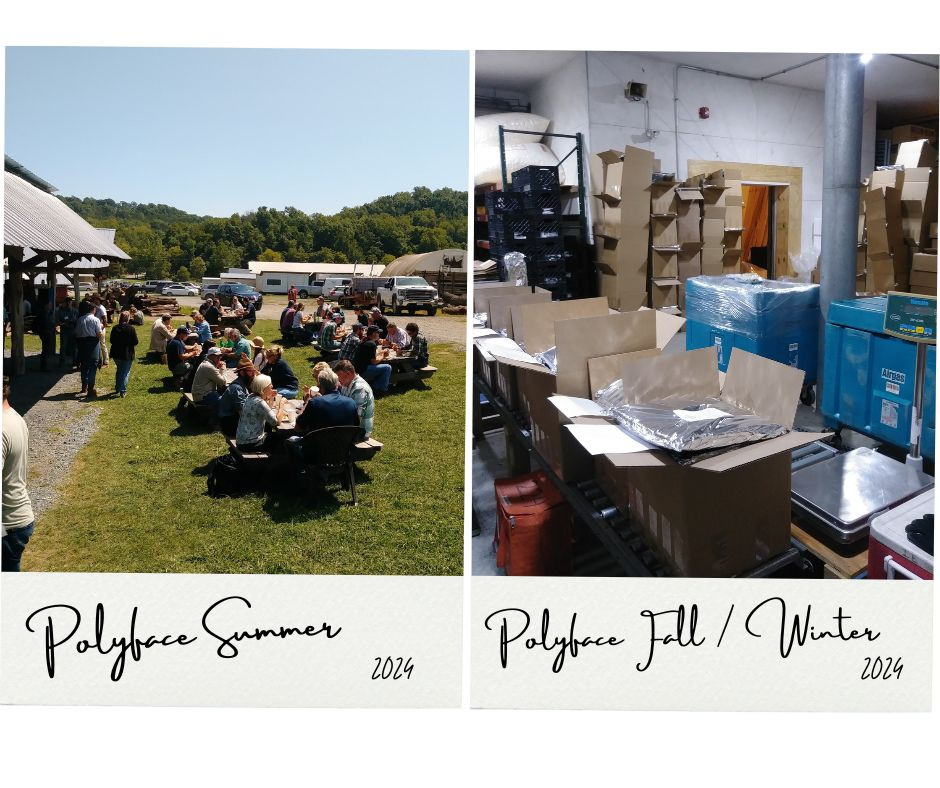
Seasons Change

written by

Melissa Barth

posted on

December 17, 2024

Farmers are well acquainted with the seasonal ebb and flow of work. 

Over the course of a year, the pace and tone of agricultural activities change. My role at the farm also shifted with the passing of seasons. 

October 1st marked the end of our summer at Polyface. This is when we bid farewell to our summer stewards and begin our fall and winter routines. 

My job transitioned from being the summer chef to assisting with shipping and inventory. 

My first week back in the shipping department was a blast! I was surprised with just how natural such a dramatic shift in work felt. 

How was it that reverting back to my shipping role was so fulfilling? 

I know there are multiple factors to this, but one of the biggest ones is that I am essentially doing the same thing. 

While peeling potatoes in the kitchen and labeling boxes in a warehouse seem very unrelated, both are bringing food to people

Polaroid.jpg

Being able to work within my calling as both a chef and shipping assistant has been very grounding and personally gratifying. 

What about you? 

Are you a farmer whose work is intrinsically tied to the changes in weather? 

Are you a person who holds seasonal positions? 

Perhaps you are someone who rarely has a change of pace in their work but longs for that. 

Maybe, on a personal level, this season for you has been really long or hard. (If so, a not-so-well-known country song comes to mind, "Seasons Change", by Scotty McCreery. This song may or may not have kept me going through the doldrums of college.) 

Seasons do change; that is the way God designed the natural world to work. If your season is not changing, perhaps consider ways you might encourage that change. Also keep in mind that if you do this current season well, when the time is right, your next season will come. 

Here at Polyface, we embrace the seasons - it's built into our very farming model because we believe this is what we were created for; it's what our bodies, our hearts, and our Earth need. 

We hope you enjoy this season. As you know, we're all taking a bit of a break for the rest of the year. Be assured that we're still taking care of the animals every day and we're still making plans for 2025 to be even better. We hope you'll partner with us next year to make the world a little better and a little brighter.


- Melissa

seasonal

methods

More from the blog

Duplication

  "How does this scale?"  Whenever someone asks me that question, the underlying assumption is that production volume requires consolidation, concentration, and centralization.           In other words, the only way to feed the world is to make bigger chicken houses in one place, bigger canneries in one place, bigger machines and bigger warehouses.  I remember well being vilified by a Smithsonian historian at a food conference where he and I were both on a panel.                     When I dared to suggest bigger is not always better, he interrupted me and ranted for 10 minutes on why bigger is always better.  "A bigger fort was always bigger than a smaller one.  A bigger gun was always better than a smaller one."  He went on and on about how historical accuracy and authenticity demands addiction to bigger.                   But biology is not forts and guns.  It's not mechanical.  Critters have an optimal size.  As animal behaviorist guru Temple Grandin says, living things demand energy for three things:  reproduction, growth, and immunological function.  All three must be in balance.  When anyone selects for only one of those traits, the other two suffer.  That's why American dairy cows only have two lactations on average.  When they milk as heavily as our one-trait genetic selection asks, they don't breed and have all sorts of sickness problems.                   Nature does not scale through concentration; it scales with duplication.  If nature wants more oak, it doesn't make one big tree; it makes acorns.  If nature wants more milk, it doesn't make a great big cow; it makes calves.  If nature wants more tomatoes, it doesn't make a monster tomato plant; it makes a bunch of seeds that make more tomato plants.  Nature scales with duplication.                   At Polyface, rather than having a chicken house big enough for 15,000 chickens, we have 170 little 120 square foot portable shelters holding 75 birds apiece and giving us cumulative capacity for 15,000.  But they're spread out in modules, duplicated, to give us the production volume.                   We run pigs in groupings of 35-50.  A Smithfield confinement facility might house 5,000 hogs in a bigger-than-football-field-sized facility.  The stench is unbearable.  By spreading these pigs out across the landscape in small groups we get the same scale without any of the ecological, immunological, or animal welfare dysfunction.                   This could even be said of farming in general.  People see the massive corn, soybean, and alfalfa farms in the mid-west and wonder how we would possibly survive without those massive, single-species outfits.  The fact is they aren't even producing food.  Half the soybeans are exported to other countries; those markets are drying up rapidly with competition from other countries like Uruguay, Paraguay, Argentina, and Brazil.  Nearly half the corn goes to taxpayer-subsidized ethanol.  The alfalfa goes to Japan and Saudi Arabia to feed racehorses.  By and large, all that production isn't even food.                   The fact is we don't need to produce all those commodities and even if we needed it all for food, we could do it in a more spread out, diversified platform.  America has 35 million acres in lawns.  We have 36 million acres housing and feeding recreational horses.  All of this could be turned into duplicative production, like acorns for oak trees.                   My point is this:  scale as commonly understood in modern American lexicon is completely anti-ecological.  The real mechanism for scale is duplication.  A more democratized production creating volume through multiplicative nodes is the way nature works.  This is why farms like Polyface, with spread out infrastructure in repeated modules offers multiple advantages.                   Polyface can't feed the world by itself, and we have no desire to build an empire trying to.  But thousands of Polyfaces can feed the world.  Indeed, they're the only way to do it for the next 500 years.  This is one reason why we invest heavily in germinating new young farmers. Our stewardship and apprenticeship programs are all about this kind of duplication.                   In fact, Aug. 21-22 we're hosting the Stockman Grass Farmer's Launching Young Farmers conference where we'll feature 8 of our graduates who were 20 years old, no money, no land, and at 40 are full-time farming without government subsidies.  If you ever dreamed of bootstrapping a farming career, you should come.  We still have room.  It will be the most profound agricultural conference in America this year.  Information is on our website on the education tab.                   For most of you, the fact that you keep us in business to duplicate production and the farmers who will carry these principles forward, indicates your heart investing in an authentic food and farming model.  Thank you for making it all possible.